


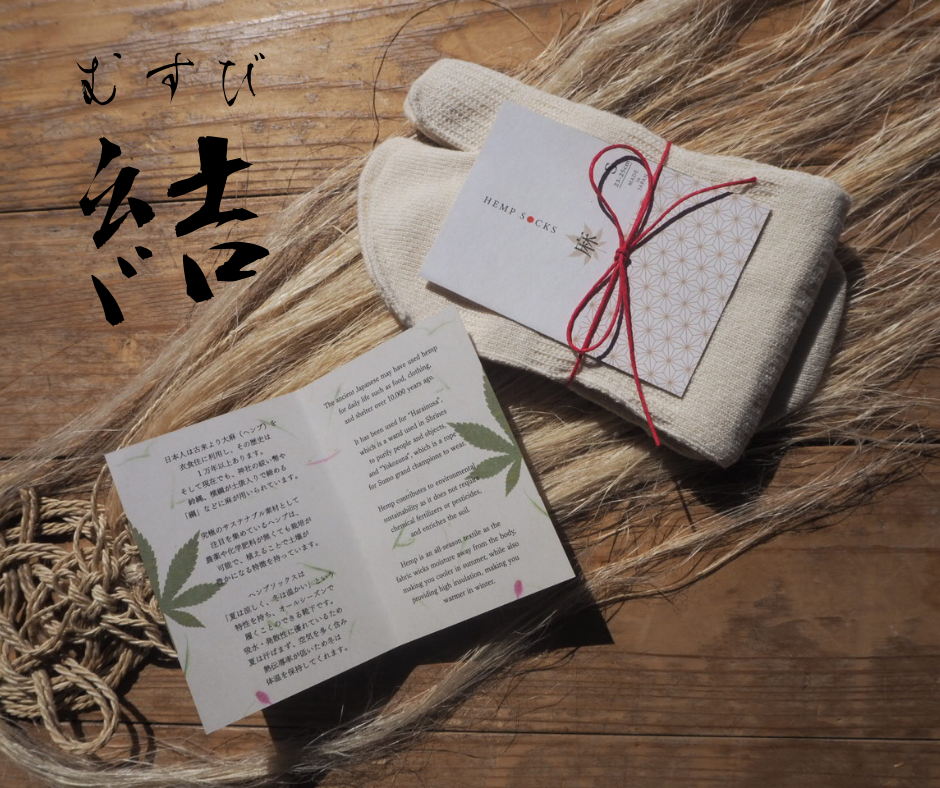


Musubi
結
We chose the name MUSUBI (結) with the wish that "people's thoughts and connections will be bound together."
We sincerely hope that MUSUBI will become a bridge that "connects" people.

hemp
Cannabis
The Japanese have used hemp for clothing, food, and shelter since ancient times, a practice that spans over 10,000 years. Even today, hemp is used in Shinto ritual offerings, bell ropes, and the ropes worn by sumo grand champions during their ring-entering ceremonies.
The ancient Japanese may have used hemp for daily life such as food, clothing, and shelter over 10,000 years ago. It has been used for “Harainusa”, which is a wand used in Shrines to purify people and objects, and “Yokozuna”, which is a rope for Sumo grand champions to wear.

Sustainable
environment
Hemp, which is attracting attention as the ultimate sustainable material, has the characteristics of being able to be cultivated without pesticides or chemical fertilizers, and enriching the soil when planted.
Hemp contributes to environmental sustainability as it does not require chemical fertilizers or pesticides, and enriches the soil.

performance
Functionality
Hemp socks have the characteristic of being "cool in summer and warm in winter," making them socks that can be worn all year round. Because they have excellent water absorption and wicking properties, they don't make you sweat in the summer, and because they have low thermal conductivity and trap a lot of air, they help retain body heat in the winter.
Hemp is an all-season textile as the fabric wicks moisture away from the body, making you cooler in summer, while also providing high insulation, making you warmer in winter.

value
High-quality domestically produced hemp
Rare, domestically produced hemp encases the paulownia wood box. In recent times, there has been a renewed appreciation for traditional Japanese hemp. We hope you will hold this genuine hemp in your hands and feel the "skill" passed down from our ancestors.

skill
technology
We have poured all of Japan's world-renowned craftsmanship into this product. We have paid meticulous attention to durability and materials, resulting in socks that combine beauty and elegance.
-

Characteristics of hemp socks
1. It has the highest strength of any natural material, and its strength increases when it gets wet.
Hemp is said to be the strongest of all natural fibers, and its strength increases when it gets wet. It also has the advantage of being resistant to deterioration even when exposed to sunlight.
2. It has excellent heat dissipation, moisture absorption and water absorption properties, and has the ability to dissipate water.
Linen, which has a hollow core, is four times more absorbent than cotton. It also has excellent wicking properties, allowing it to dries quickly. This means that even when you sweat, it won't stick to your skin, making it comfortable to wear.
3. Socks that can be worn all year round.
Hemp is a porous fiber, so it has high breathability and thermal conductivity, making it cool in the summer and warm in the winter.
4. It is a sustainable material that is good for the global environment.
Unlike cotton, hemp cultivation does not require pesticides or chemical fertilizers, is resistant to weeds and pests, and has the advantage of producing a relatively high yield per unit area. Furthermore, planting hemp not only improves the soil, but also requires little energy to grow, so it has a small impact on the global environment.
-

About "Asana"
Although the term "hemp" is generally used, it is said that there are around 20 similar varieties, including cannabis, flax, ramie, jute, Manila hemp, and sisal.
In English-speaking countries, there is no general term like the Japanese "asa," and "marijuana" from the Cannabaceae family is called "hemp," "flax" from the Linaceae family is called "linen," "ramie" from the Urticaceae family is called "ramie," and "jute" from the Tilia family is called "jute." In other words, although they are all lumped together as "asa," there is no botanical relationship between them.
In addition, industrial hemp is a term that refers to cannabis used for industrial purposes. Medicinal cannabis, which is generally used for recreational or medical purposes, is called "marijuana," while intermediate or fiber cannabis, which is used for fiber and food, is called "industrial hemp."
This difference is determined by the ratio of two compounds, THC and CBD, with THC being the compound that gives marijuana its effects. In Europe, Canada, Australia, and other countries, varieties with a THC content of less than 0.3% are called industrial hemp.
The industrial hemp used in this product is a traditional Japanese fiber that is friendly to both people and the global environment.
-

About "Cannabis (Hemp)"
Cannabis originates from the coast of the Caspian Sea in Central Asia, and is an annual plant of the Cannabaceae family. It grows 3-6m tall and is characterized by its ability to grow straight up. The fiber extracted from the stems is a beautiful golden color, and it has been carefully cultivated since ancient times in countries around the world. Cannabis has a strong vitality, so it adapts quickly and is relatively durable. To use it as fiber requires manpower, skill, and perseverance, but the processed products produced from it are useful in all aspects of life, including food, clothing, and shelter.
The stems, from which fiber and wood are obtained, and the seeds, from which hemp nuts and hemp seed oil are obtained, are both legal in Japan.
Hemp fibers have been used in Shinto rituals since ancient times, such as in shimenawa ropes, and hemp leaf patterns are dyed with indigo on baby clothes to ward off evil and pray for the baby's growth. Hemp is a familiar symbol of prayers and wishes for the Japanese.
-

The history of hemp
Hemp is one of the plants that has been used since ancient times.
Hemp is depicted in the murals of the Egyptian pyramids, and linen thread was also used in the cloth used to wrap mummies.
On the other hand, although it is not known exactly when hemp began to be used in Japan, the Japanese have been cultivating it since early times, dating back to the early Jomon period 12,000 years ago.
Hemp ropes, hemp knitting, and hemp fruits have been discovered at the Torihama Shell Mound Ruins in Fukui Prefecture.
Furthermore, hemp-related items have been excavated at the Shobudasaki Shell Mound in Akita Prefecture, the Kiusu 4 Site in Hokkaido, the Shimoyakebe Site in Tokyo, and the Miyanosako Site in Kagoshima Prefecture.
There was nothing to throw away from hemp, so it was put to good use. The fruit of the plant was used for food and oil, the fiber from the stems was used for clothing, fishing nets, fishing lines, bags, ropes, bowstrings, etc., the core of the stems was used as building material, and the fiber scraps were used as insulation. In addition, traditional Japanese paper began to be made from hemp.
The Manyoshu, which is thought to have been compiled during the Nara period from the late 7th century to the 8th century, also contains many poems that describe scenes of hemp harvesting, as well as poems related to hemp thread and cloth.
In Shinto, hemp is defined as something that wards off sin and impurity. Hemp is also said to be a symbol of Amaterasu Omikami, and was an important plant for the imperial family, and was originally only allowed to be displayed on the Shinto altar.


